
SPECIAL EVENT COVERAGE
Emergent Health Partners | Huron Valley Ambulance | Jackson Community Ambulance | LifeCare Ambulance | Monroe Community Ambulance | Lenawee Community Ambulance | Albion Community Ambulance
EVENT MEDICAL COVERAGE
Does your event need medical coverage?
Emergent Health’s ambulance services are experienced in event medical coverage and can meet your needs for effective and well-coordinated safety measures.
Staffing & Medical Equipment
- Up to 80 licensed EMS providers
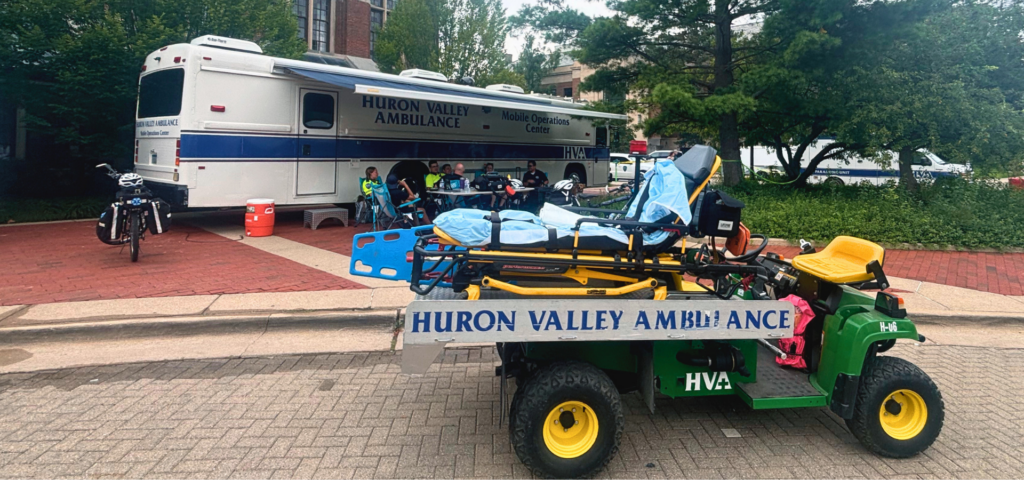
- Well-equipped bike response paramedics
- Basic Life Support and Advanced Life Support ambulances
- A fleet of event response utility vehicles (Gators)
- A Mobile Command Center
- A designated 911 Dispatcher.
- A special events medical communications center.
- Medical tents
- Mobile medical kits

What Type of Events?
- First Aid and Medical Tents
- Fairs and Festivals
- High School and College Athletic Events
- Motor Vehicle Sports: BMX, Motocross, Derbies
- 5Ks and Marathons
- Large events with a high number of attendees
The Coverage you Need
Our Special Event Coordinators will work with you to develop an event coverage plan that meets your needs, provides necessary safety for attendees, and takes your budget into consideration.
Menu of Services
BLS Transporting Unit
Two (2) EMTs and a Basic Life Support ambulance with the capability to transport patients to a receiving hospital, as needed.
BLS-level providers:
- Perform life-saving interventions such as CPR, airway management, and AED use.
- Carry limited medications for patient treatment.
Considerations:
- This option allows care to be initiated in emergencies while keeping an affordable price point for the event host.
- Basic Life Support units have fewer capabilities than Advanced Life Support units – in a critical event, an ALS unit will need to be called in.
ALS Transporting Unit
One (1) paramedic, one (1) EMT, and an Advanced Life Support ambulance with increased capabilities to care for critical patients.
ALS Providers:
- Provide a higher level of emergency care than BLS providers.
- Carry the same level of equipment as BLS providers, with added Advanced Life Support equipment and medications.
- Can administer medication and has a higher level of skills, training, and life-saving measures, compared to a BLS unit.
Considerations:
- Know what level of response your event requires – some insurance providers or contracted organizations may require an ambulance on site. Other organizations may take their emergency response requirements a step further and require the ambulance to have ALS capabilities.
MICU Transporting Unit
One (1) Mobile Intensive Care Unit-level paramedic, one (1) EMT, and an ALS ambulance.
MICU-level providers:
- Specialize in the transport of critically ill patients from one hospital to another.
- Offer a higher level of definitive care than an ALS unit.
- Carry the same equipment as an ALS unit, plus specialty care equipment.
- Have additional specialized training beyond an ALS paramedic.
Considerations:
- This option is typically not used at events and is reserved for specialized medical care.
ALS Bike Team
One (1) paramedic and one (1) EMT, at a minimum, with a set of bicycles and limited Advanced Life Support equipment.
ALS Bike Teams Providers:
- Provide ALS care in the field.
- Have maneuverability – they can easily get around in large or crowded areas.
- Best suited for fairs, marathons, or other crowded events with limited road accessibility.
Considerations:
- Bike team providers begin care where the patient is located, but cannot move the patient.
- Non-mobile patients will require additional units to move them (See “ALS Gator Unit.”)
- This option does not include an ambulance.
Special Event Nurse
One (1) licensed RN.
Special Event RNs:
- Are available to work at events with medical or First Aid tents.
- Are also licensed paramedics with Emergent Health Partners.
Considerations:
- RNs cannot transport to the hospital.
- This option does not include an ambulance.
- Our RNs are trained as paramedics and can offer stabilization or First Aid to patients with a medical emergency, but cannot provide medical care outside of the scope of an RN.
BLS First Response Team
Two (2) EMTs with backpacks containing limited BLS supplies.
BLS First Response Teams:
- Provide initial emergency and First Aid care.
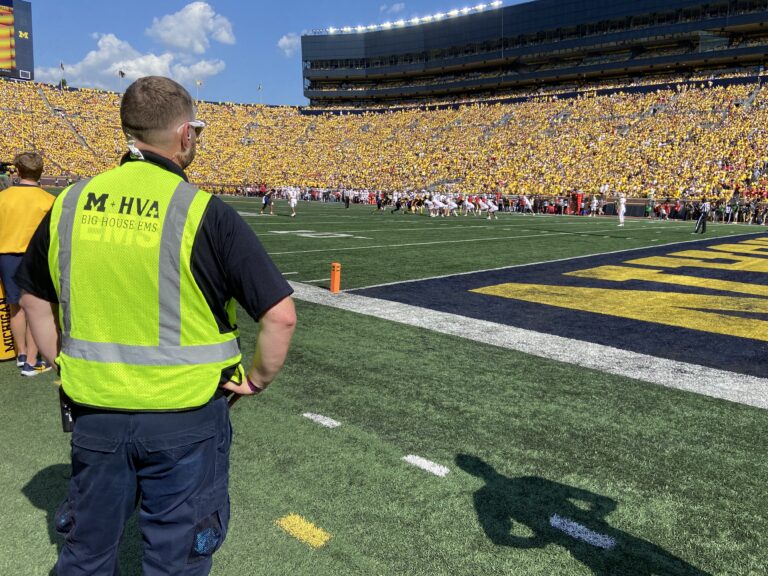
- Are often used at large stadiums, concerts, or events with a high number of concentrated attendees.
- Can be staged throughout the event space to respond quickly to patients not accessible by other unit types.
Considerations:
- A first response team begins care where the patient is located, but cannot move the patient.
- Non-mobile patients will require additional units to move them. (See “BLS Gator Unit.”)
- This option does not include an ambulance.
ALS First Response Team
One (1) paramedic and one (1) EMT with backpacks containing limited ALS supplies.
ALS First Response Teams:
- Provide initial Advanced Life Support care – a higher level of care than BLS providers.
- Are often used at large stadiums, concerts, or events with a high number of concentrated attendees.
- Can be staged throughout the event space to respond swiftly to patients not accessible by other unit types.
Considerations:
- A first response team begins care where the patient is located, but cannot move the patient.
- Non-mobile patients will require additional units to move them. (See “ALS Gator Unit.”)
- This option does not include an ambulance.
Single BLS First Responder
One (1) licensed provider with limited care capabilities.
BLS First Responders:
- Typically work out of medical tents and First Aid stations at smaller events.
- Will have a rolling cart of medical supplies and limited advanced life-saving equipment when working in a medical tent, and will be able to provide First Aid.
Considerations:
- This option does not include an ambulance.
- The provider will not be able to move immobile patients or transport them to the hospital.
Single ALS First Responder
One (1) paramedic-level provider.
ALS First Responders:
- Typically work out of medical tents and First Aid stations at smaller events.
- Will have the same supplies and capabilities as the BLS first responder, but will have additional capabilities and life-saving equipment.
Considerations:
- This option does not include an ambulance.
- The provider will not be able to move immobile patients or transport them to the hospital.
BLS Gator Unit
Two (2) providers with limited BLS capabilities and a Gator utility vehicle.
BLS Gator Units:
- Provide initial emergency and First Aid care.
- Can maneuver through crowds and limited access locations in a golf cart-sized UTV.
- The Gator is equipped with a stretcher, allowing the providers to move an immobile patient to an egress point.
- Most often used at large stadiums, marathons, and limited-access trails.
Considerations:
- This option does not include an ambulance.
- The provider will not be able to transport to the hospital.
ALS Gator Unit
One (1) paramedic, one (1) EMT, and a Gator utility vehicle.
ALS Gator Units:
- Provide initial Advanced Life Support care – a higher level of care than BLS providers.
- Can maneuver through crowds and limited access locations in a golf cart-sized UTV.
- The Gator is equipped with a stretcher, allowing the providers to move an immobile patient to an egress point.
- Most often used at large stadiums, marathons, and limited-access trails.
Considerations:
- This option does not include an ambulance.
- The provider will not be able to transport to the hospital.
Dispatcher
One (1) dedicated 911 dispatcher.
911 Dispatchers:
- Are required for large-scale events.
- Will typically be stationed at our Dispatch Center in Ann Arbor.
- Will be present on-site at events if alternative dispatch capabilities are available.
Considerations:
- Events with 3,000 or more expected attendees require a dedicated dispatcher.
Supervisor/Event Coordinator
One (1) dedicated EMS Supervisor.
EMS Supervisors:
- Coordinate logistics and communications for medical staff.
- Ensure medically safe response for all event attendees.
- Act as an event liaison should medical needs arise.
- Typically are used at events with a large number of expected attendees requiring multiple EMS response teams.
Considerations:
- An EMS Supervisor is required at larger events.
- This option does not include an ambulance.
- An EMS Supervisor is not a standalone option.
Get in Touch
Regional Special Event Coordinators
Event coverage is available throughout our service area. Please contact the Special Event Coordinator in the county where your event is taking place.
Huron Valley Ambulance
Washtenaw, Wayne, and Oakland counties
Shane Flynn, Paramedic Supervisor
[email protected] | 734-477-6336
Jackson Community Ambulance
Jackson and Lenawee counties and the City of Albion
Michele Wheeler, Administrative Assistant
[email protected] | 517-841-4803
LifeCare Ambulance
Branch, Barry, Calhoun, Eaton, Hillsdale, Kalamazoo, and St. Joseph counties.
Lori Phillips, Operations Manager
[email protected] | 269-565-8043
Monroe Community Ambulance
Monroe County
Eric Farris, Paramedic Supervisor
[email protected] | 734-368-6601